
Search for hair restoration and you will quickly run into the dhi vs fue debate, usually framed as a contest between two rival procedures. Some ads present DHI as the newer, more advanced option. Others dismiss it as a marketing label. Both framings miss the point, and they can push you toward paying for something you may not need.
Here is the plain version: DHI is not a separate way of harvesting hair. It is a way of placing grafts that sits inside an FUE procedure. The grafts come out of the donor area the same way in both cases, and the difference shows up only in how they go back into the thinning area. Our page on DHI-style placement at our Aventura clinic walks through how we use the implanter pen. This guide steps back and explains where that tool genuinely earns its place, where classic placement does the job just as well, and how to decide which approach suits your scalp.
What DHI Actually Changes
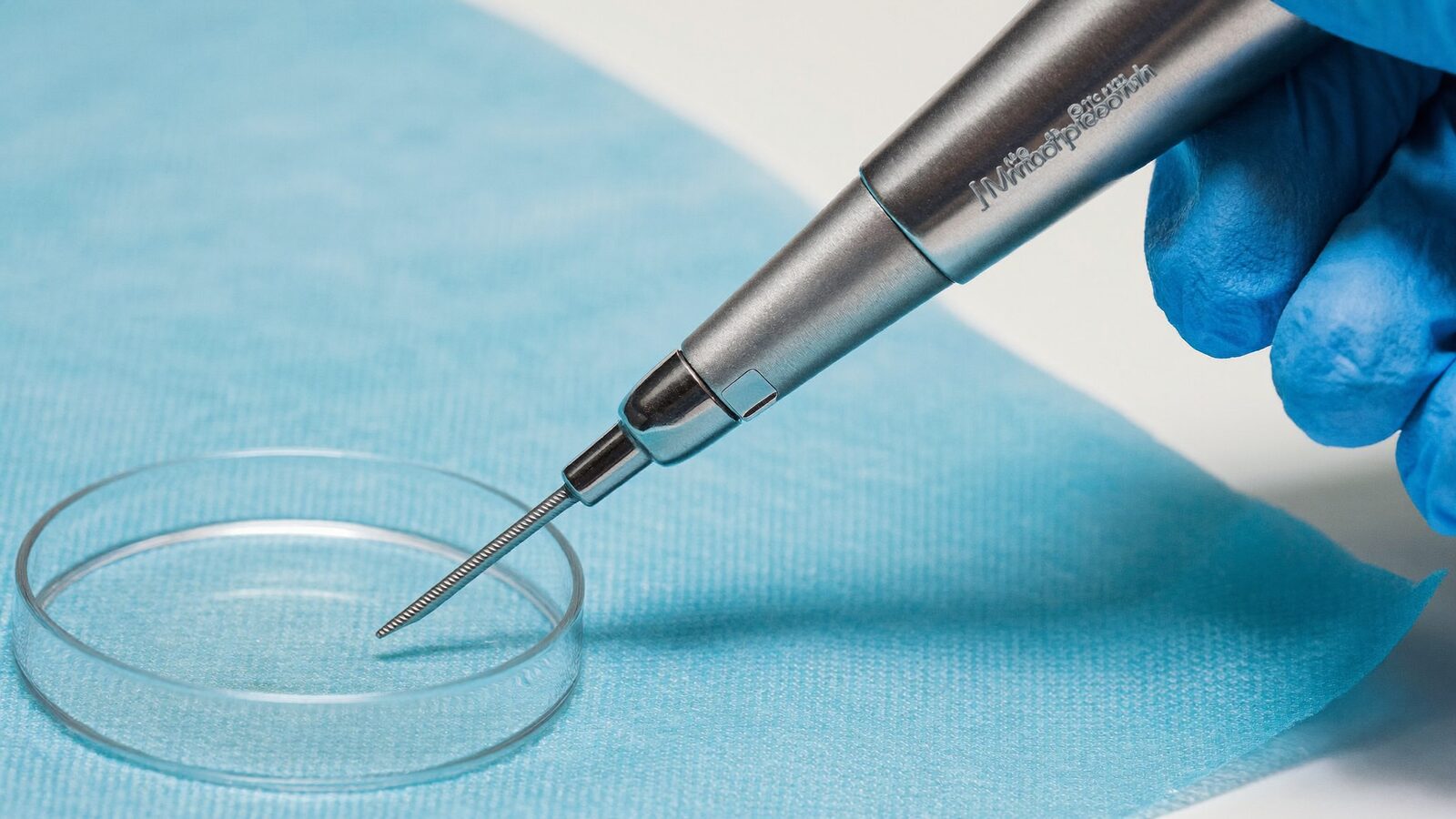
DHI stands for direct hair implantation. The name refers to one specific change in the workflow: instead of opening all the recipient sites first and then setting grafts into them with forceps, the team loads each graft into a hollow, pen-shaped implanter and places it in a single motion. The needle tip of the pen creates the opening and the graft slides in as the plunger is pressed.
That is the whole difference. Everything before the grafts reach the implanter is unchanged, and everything after placement (healing, shedding, regrowth) follows the same timeline. To make the comparison concrete, it helps to break the day into its working parts.
| Step | Classic FUE placement | DHI-style placement |
| Plan and hairline design | Same | Same |
| Extraction from the donor area | Individual follicular units removed by hand | Identical: individual follicular units removed by hand |
| Opening recipient sites | Done in advance with a fine blade or needle | Done at the moment of placement by the pen tip |
| Setting grafts | Forceps place each graft into a premade site | Graft is loaded into the pen and pushed in directly |
| Typical team rhythm | Site-making phase, then placing phase | Loading and placing happen together, graft by graft |
| Healing and growth timeline | Roughly 12 months to a mature result | Roughly 12 months to a mature result |
Notice how little of the table differs. When a clinic advertises DHI as a whole procedure, what it really sells is one stage of a longer process. That does not make the pen useless. It just means the decision is narrower than the marketing suggests.
Extraction Is the Same
The donor work is where most of the long-term risk in any hair transplant lives, and DHI does not touch it. Whether grafts will be placed with forceps or a pen, they are first removed one follicular unit at a time from the back and sides of the scalp. At our clinic that is done by hand with fine handheld FUE instruments by the surgical team, not with robots or suction devices. If you are curious about the machine-assisted alternatives, our comparison of manual FUE and devices like NeoGraft or ARTAS covers that question separately.
Because extraction is identical, the things that protect your donor area are identical too:
- Spacing: grafts are taken in a spread pattern so the donor zone still looks full when your hair is cut short.
- Daily limits: we harvest up to about 4,000 grafts in one day, depending on donor density, and very large plans are split into two sessions.
- Reserve: some donor capacity is deliberately left untouched for hair loss that may continue in later years.
- Graft quality: careful handling, hydration and short time out of the body matter whether the next tool is a pen or forceps.
So if someone tells you DHI is gentler on the donor area, ask how. The answer, honestly given, is that it is not. The donor scalp sees the same small round extraction points either way, and those heal into tiny dots that are usually hidden by hair of a few millimeters. For a full picture of how the harvest works, see our follicular unit extraction overview.
Where the Implanter Pen Helps
The pen is a precision tool, and there are situations where it makes life easier for the team and the result more predictable for you. These are the cases where we are most likely to recommend DHI-style placement.
Working between existing hair
If you still have reasonable native hair in the area being treated, every new opening has to slip between living follicles without injuring them. Because the pen creates a site and fills it immediately, the team never has to hunt for a premade opening hidden among existing strands. That can reduce handling of the graft and keep placement tidy in crowded areas.
Unshaven or partly shaved procedures
Patients who cannot take time off and want to keep the top long often ask about doing the work without a full shave. The pen can be useful here, since the team works through gaps in longer hair. Not everyone qualifies for this, because the donor area usually still needs some trimming and not every plan can be done this way.
Fine angle control in small zones
Along a hairline or temple point, grafts need to sit at very low, consistent angles. The pen lets the placer set angle and depth in one action, which some teams find helpful for small, detailed areas. In practice it is one way, not the only way, to achieve that control.
Good to know: the pen is most useful when its strengths match a specific problem, such as dense native hair or a no-shave request. On a fully bald, shaved area those strengths matter much less.
Where It Adds Cost Without Benefit
There is a quieter side to the comparison that ads rarely mention. On open, fully thinned areas, such as a large bald crown or a broad frontal zone with little native hair left, classic forceps placement into premade sites does the job very well. Premade sites let the team plan the whole recipient pattern up front, check spacing and direction across the area, and then place grafts quickly and evenly.
Using a pen in those zones tends to add time without adding growth. Pens need to be loaded one graft at a time, and many teams keep several instruments in rotation, so the placement phase can become slower and more labor intensive. In clinics that charge more for DHI, that extra time shows up on the invoice. Common ways the cost creeps up include:
- A technique surcharge: some clinics price DHI as a premium package even when only part of the area benefits from the pen.
- Smaller sessions for the money: slower placement can mean fewer grafts per day at a higher total price.
- Disposable instrument fees: single-use pens or tips are sometimes billed separately.
Our pricing is per graft, from $3.99 to $7.99, with no session fees, and you receive a written quote after a free consultation. You can see how those numbers come together on our hair transplant cost page. If a quote elsewhere is much higher purely because the word DHI appears on it, ask what part of your scalp actually needs the pen and why.
The same logic applies to other branded upgrades. Our article on sapphire FUE looks at a similar question for recipient-site blades: a real tool, sometimes useful, but rarely the deciding factor in how your hair looks a year later.
What Matters More Than the Placement Tool
When you compare outcomes from patients a year after surgery, the instrument used to set grafts is rarely what separates a natural result from an obvious one. These are the variables that usually carry more weight:
- Hairline design: a soft, irregular front edge that suits your age and face, not a straight line drawn for today.
- Graft distribution: single-hair grafts at the front, multi-hair grafts behind them for density.
- Direction and angle: matching the way your hair naturally grows so it lies flat and blends.
- Donor planning: taking only what your donor area can spare, with reserve kept back.
- Aftercare: protecting the scalp from strong Miami sun, sweat and pool water in the first weeks.
Every plan at our clinic is reviewed and approved by Dr. Adam Rubinstein, MD FACS, a board-certified plastic surgeon who oversees the procedure. Dr. Rubinstein designs the plan with you, including the hairline and the zones where the pen may or may not be used, so the tool choice follows the plan rather than driving it.
Choosing Between Them
For most people the question is not DHI or FUE but which placement method fits each area of the scalp. Many plans combine both: forceps into premade sites across a broad bald zone, and the pen along the hairline or through areas with dense native hair. Use these scenarios as a rough guide, then confirm the details at consultation.
| Your situation | Placement that often fits | Why |
| Early thinning with plenty of native hair on top | DHI-style pen | Places grafts between existing hairs with less disturbance |
| Want to keep the top long for work | DHI-style pen, partial shave | Works through gaps in longer hair if the plan qualifies |
| Large bald crown or fully bald front | Classic forceps placement | Premade sites allow fast, even coverage with no added benefit from the pen |
| Mixed pattern, bald crown and thinning front | Combination | Each zone gets the tool that suits it |
| Large plan above one day's capacity | Either, over two sessions | Donor protection sets the pace more than the tool |
If you are still deciding on the bigger technique question, such as whether strip harvesting might suit you better than individual extraction, our guide to FUE vs FUT covers that first decision. The placement question only comes after you know how grafts will be harvested.
Questions to Ask Any Clinic About DHI
Whether you consult with us or compare several clinics around Miami-Dade and Broward, these questions help cut through the labels quickly:
- Which parts of my scalp would get the pen, and which would not? A clear answer shows the tool is matched to your pattern rather than sold as a package.
- Is extraction any different from your standard FUE? It should not be. If it is, ask exactly what changes.
- Does DHI change my price? Ask for a written, per-graft quote so you can compare like with like.
- How many grafts can you safely take from my donor area? This number matters more than any placement method.
- Who designs the plan and who oversees the day? You should know which doctor reviews your plan and how the surgical team is supervised.
If you live outside the area, you can start with an online consultation using photos and a video call before you visit Aventura. We also provide complimentary transportation to and from the clinic for patients who travel. Either way, you will leave the conversation knowing which placement method makes sense for your scalp and why, without paying extra for a label.
Find Out Which Placement Method Fits Your Scalp
Book a free consultation in Aventura or start online with photos and a video call. We will map your plan zone by zone and give you a written per-graft quote.