
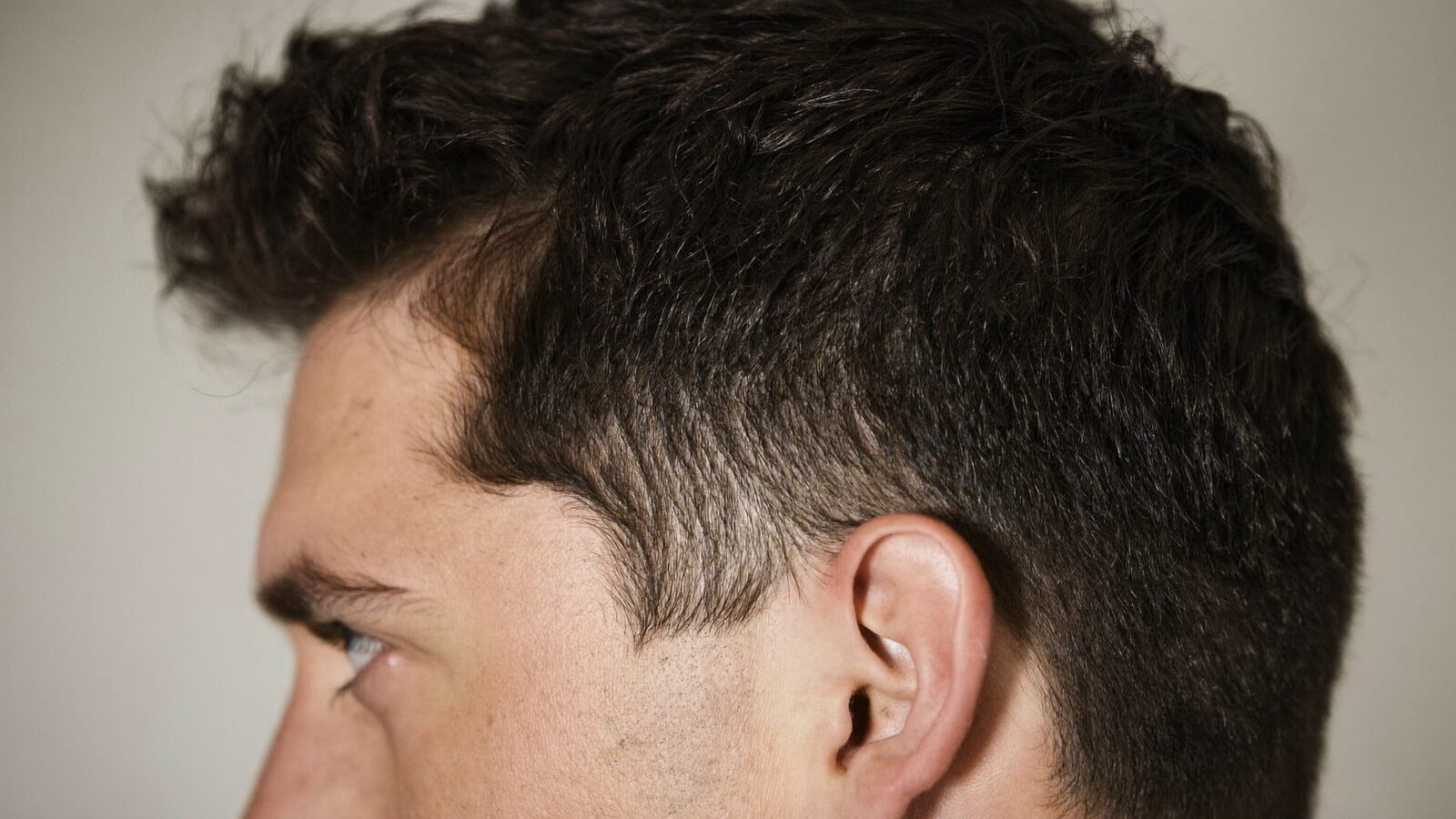
Most people who talk about hair loss talk about the hairline across the forehead or the thin spot on the crown. Very few mention the two small triangles of hair that sit just in front of each ear, below the corners of the forehead. Those triangles are the temple points, and when they fade, the whole face starts to look a little older, a little longer and a little less defined, even if the front hairline is mostly intact. Temple point restoration is the procedure that rebuilds them, one graft at a time.
It is detailed, low-volume work, and it is one of the places where placement skill matters more than graft count. At our Aventura clinic, temple work is almost always done with follicular unit extraction (FUE) at our Miami clinic, because individual grafts can be taken from the back of the scalp and set at the extremely flat angles this zone needs. This guide explains what temple points are, why they change the frame of the face, how the grafts are angled and spaced, roughly how many it takes, and how the approach differs for women.
What Temple Points Are
Look at a man with a full, untouched hairline in profile. Above the ear you see the sideburn, and above and slightly in front of the sideburn there is a small peninsula of hair that points forward toward the outer corner of the eye. That forward-pointing tip is the temple point. Between it and the front hairline sits a soft notch of bare skin called the temporal recess, which is a normal part of a mature adult hairline.
So the side of the face really has three connected pieces: the frontal hairline, the temporal recess, and the temple point that flows down into the sideburn. When all three are present, the hair forms a continuous frame from the forehead to the jaw. When the temple point disappears, the sideburn looks like it stops in mid-air and the side of the head reads as a wide, bare patch.
How temple points are lost
- Pattern hair loss: In many men the temple points thin and retreat as part of the same process that deepens the temporal recesses, so the corners of the hairline and the points fade together.
- Age: Even men with stable front hairlines often notice the points become shorter and sparser with time.
- Traction and styling: Tight braids, ponytails or headwear that pulls at the sides can wear down hair along the temples over years.
Why They Matter for the Face
Temple points do a job that is easy to miss until it is gone. They narrow the visual width of the upper face, give the eyes a defined border on each side and connect the hairline to the beard area. Restore them and the face tends to look more balanced and youthful. Leave them out, and even a well-designed front hairline can look like a strip of hair pasted onto a large, open forehead.
This is why experienced hairline planners think of temples as part of the frame rather than an optional extra. A man who receives a strong frontal hairline but bare temples often ends up with a result that looks unnatural from the side, because the eye expects hair to wrap around toward the ear. Our article on matching the hairline to your face shape goes deeper into how the overall outline is chosen, and the temples are where that outline finishes.
Profile photos are the most honest test. In South Florida, where short cuts, slicked-back styles and wet hair after the pool or beach are common, the side profile is visible more often than in colder places where hats and longer styles hide it.
Quick self-check: Take a photo in profile with your hair pushed back. If the line from your sideburn upward simply fades out instead of ending in a small forward-pointing tip, your temple points have likely receded.
Graft Angles and Density
Temple hair grows differently from almost any other hair on the scalp. It lies extremely close to the skin, often at a very acute angle, and points forward and downward toward the eye and cheek. Hair at the front hairline points mostly forward; hair at the temple point turns and runs nearly parallel to the side of the face. If grafts are set at a steeper angle, the new hair sticks out like bristles and looks obviously transplanted.
That is why temple work depends so heavily on careful planning before the first graft is placed. The direction of every recipient site has to follow the existing flow of hair around it, which usually changes subtly across the area. Dr. Adam Rubinstein, MD FACS reviews and approves the design, and the team creating the sites follows that map closely.
What makes the temple zone different
- Angle: Sites are made very flat to the skin so the hair lies down rather than standing up.
- Direction: Grafts point forward and downward, rotating gradually as they approach the sideburn.
- Graft size: Almost exclusively single-hair grafts at the edges, because multi-hair grafts look too heavy at the tip of a temple point.
- Edge pattern: The outline is kept slightly irregular, since a perfectly straight edge never occurs in nature.
Hair character matters too. Fine, straight, light-colored hair needs more grafts to look dense, while coarse or wavy hair covers more skin per graft.
How Many Grafts It Takes
Because the zone is small, temple point restoration is one of the lower-graft procedures in hair restoration. The exact figure depends on how much has been lost, how large you want the points to be, your hair character and whether the temples are part of a bigger plan. The ranges below are typical starting points, not promises.
| Situation | Typical grafts | Notes |
| Mild softening of both points | Roughly 200 to 400 total | Often a refining touch, single-hair grafts only |
| Clear loss on both sides | Roughly 400 to 800 total | Rebuilds a defined point that connects to the sideburn |
| Temples plus temporal recesses | Roughly 800 to 1,500 total | Corners and points designed together as one frame |
| Temples within a full hairline plan | Part of a 1,500 to 3,000+ graft session | Temples are usually added after the front is set |
Pricing follows the same per-graft model as any other procedure at the clinic: $3.99 to $7.99 per graft, with no session fees and 0% financing for the first 12 months. A small temple case therefore lands at the lower end of the usual $4,000 to $15,000 range, and you receive a written quote after a free consultation.
Should temples come first or last?
For most men, the front hairline and the corners come first, because they define the overall shape. Temples are then designed to meet that line naturally. If you also have crown thinning, the priority question gets bigger, and our article on whether to put grafts in the crown or the hairline first explains how the donor budget is shared. Our team protects the donor zone and leaves reserve for future loss, which is one reason temples are planned together with everything else rather than as a standalone afterthought.
What the Procedure Looks Like
A temple case follows the same steps as a larger FUE procedure, just on a smaller scale. It is done under local anesthesia, with oral pain relief available if you want it, and you go home the same day.
- Design: The planned points are drawn on the skin with you looking in a mirror, so you can see the shape before anything is done.
- Extraction: Grafts are taken by hand from the back of the scalp with fine handheld FUE instruments, choosing finer hairs where possible for the temple edges.
- Site creation: Tiny recipient sites are made at the flat angle and forward direction mapped in the design.
- Placement: Grafts are set into the sites one at a time, single-hair grafts at the front edge and slightly fuller grafts behind them.
- Aftercare and follow-up: You leave with written instructions and 12 months of follow-up to track growth.
Because the number of grafts is small, the session is often shorter than a full hairline day. The temples sit close to the face, so mild swelling around the forehead or eyes can appear for a few days. New hair usually begins to show around three to four months, with the final look developing over roughly a year. Sun protection matters here, since the temples are exposed every time you are outdoors, so plan to use a loose hat or shade during the first weeks.
Temple Work for Women
Women's temples are shaped differently from men's. Instead of a pointed peninsula aimed at the eye, the female temple tends to be a softer, rounded curve that flows from the front hairline down to the sideburn area without a deep recess. The goal is a gentle, continuous frame rather than a sharp angle, and copying a male temple design onto a female face looks wrong immediately.
Women most often ask about temples for a few reasons. Some have thinning from years of tight hairstyles, extensions or weaves that pulled at the sides. Others have a naturally high or wide hairline and want the face to look more framed. Some notice changes after a brow lift or facelift moved the hairline back. In each case, the first job is to find out why the hair was lost, because diffuse thinning across the scalp may respond better to medical treatment than to surgery.
When a woman is a good surgical candidate, the same principles apply: single-hair grafts at the edges, flat angles and a carefully mapped direction. Graft counts are often modest because the aim is softening rather than building a sharp point. Our page on female hair transplants in Miami covers candidacy in more detail. Women whose main concern is a high forehead overall may also want to read about hairline lowering with surgery or grafts, since the temples are usually part of that plan.
Is Temple Point Restoration Right for You?
Temple restoration tends to work well for people whose hair loss is reasonably stable, who have a healthy donor area and who mainly want the frame of the face restored. It is less suitable when loss is still progressing quickly, since native hair around the temples may keep thinning, or when the donor supply needs to go to larger areas first.
Questions worth asking at any consultation:
- Design: Will the temple shape be drawn on me before the procedure, and can I see it in a mirror?
- Graft type: How many single-hair grafts will be used at the edges, and how will the angle be controlled?
- Donor planning: How does this fit into my lifetime donor budget if I lose more hair later?
- Examples: Can I see side-profile results, not just front views? Our before and after gallery is a good place to start.
- Medical support: Should I also be on medication or PRP to protect the hair I still have?
Temples are a finishing detail, and they look most natural when the rest of the frame supports them.
See What Restored Temples Would Look Like
Book a free consultation in Aventura or start online with photos and a video call. We will map your temple points and give you a written graft quote.