
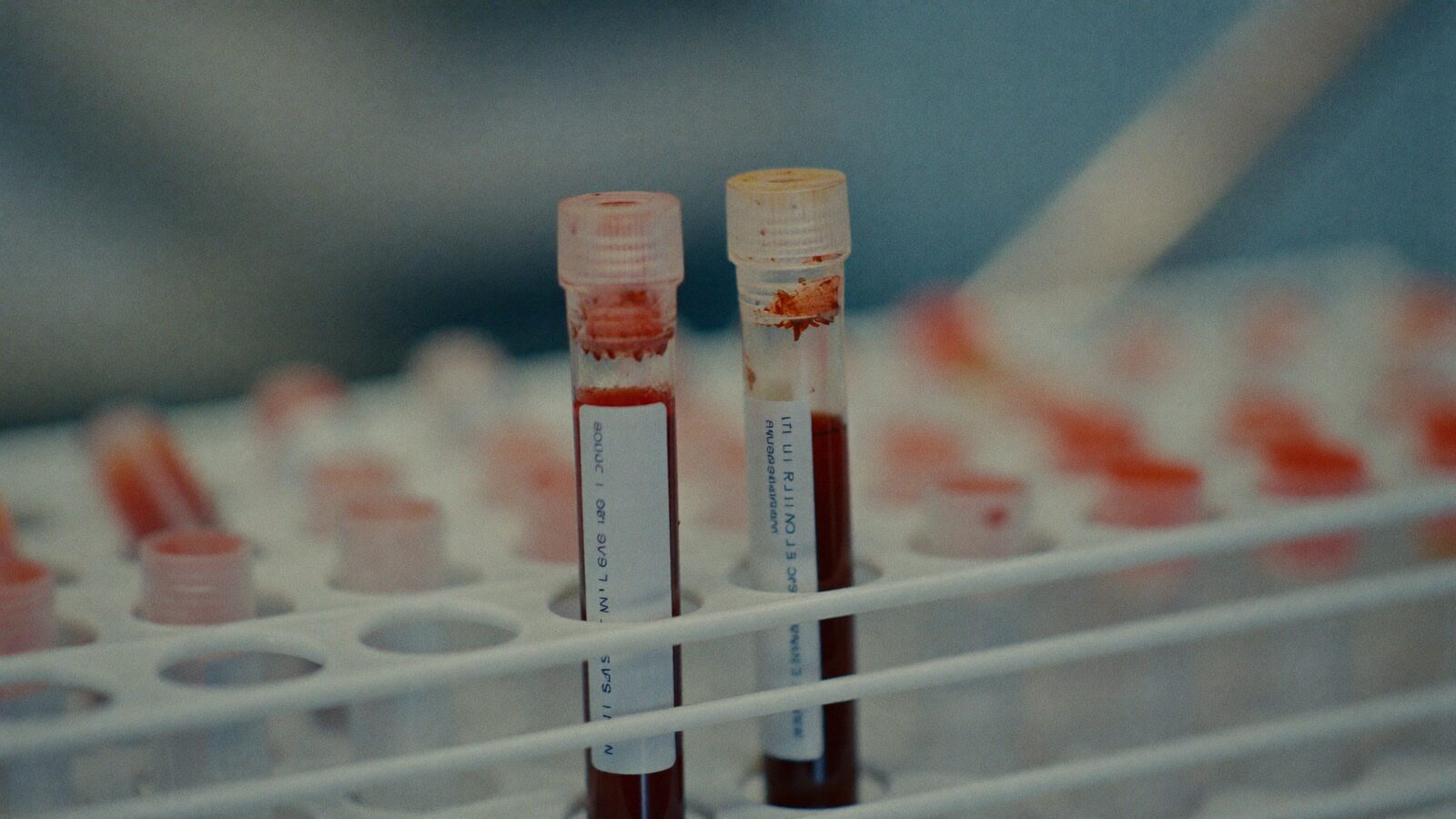
If you have started reading about injections for thinning hair, you have probably run into two acronyms that sound almost identical. The question of PRF vs PRP comes up in a lot of consultations, usually from patients who saw one term on social media and the other on a clinic website. Both are made from your own blood, both are spun in a centrifuge, and both aim to deliver platelets and growth factors to the scalp. The differences sit in how each one is prepared and how it behaves once it is injected.
Below we compare how each is made, how growth factor release differs and what the research supports. At our Aventura clinic, PRP treatment for hair loss is offered as a separate service. PRF is not part of our listed treatments, so we explain it here neutrally, as background to help you ask better questions wherever you are evaluating care.
The short answer: same source, different processing
PRP stands for platelet-rich plasma. PRF stands for platelet-rich fibrin. Each starts with a small draw of your blood, usually from the arm, taken on the day of treatment. What happens next is where they part ways.
PRP is processed so that the blood cannot clot, then concentrated so the platelets sit in a liquid that can be injected right away. PRF is processed without an anticoagulant, so it begins to form a soft fibrin network shortly after the spin. Supporters of PRF argue that this network holds platelets and some white blood cells in place and lets growth factors trickle out over a longer window. Supporters of PRP point out that it has a much longer track record in hair loss and a more established body of published work.
| Feature | PRP (platelet-rich plasma) | PRF (platelet-rich fibrin) |
| Source | Your own blood | Your own blood |
| Anticoagulant in the tube | Yes, to keep it liquid | No, so a fibrin matrix forms |
| Typical spin | Often one or two spins, faster speeds | Usually a single gentler, slower spin |
| Working time | Stays liquid, no rush | Must be injected within minutes |
| Growth factor release | Thought to be quicker, front-loaded | Thought to be slower and more gradual |
| Research for hair | Larger body of studies, still mixed | Smaller and newer, early-stage |
| Offered at our Aventura clinic | Yes, as a separate treatment | Not listed among our treatments |
How PRP is made
A PRP session starts with a blood draw into tubes that contain an anticoagulant. That additive is the defining step: it stops the blood from clotting so it can be separated and handled as a liquid.
The tubes then go into a centrifuge. Spinning separates the blood into layers by weight. Red cells sink to the bottom, a thin whitish layer sits in the middle, and the yellow plasma rises to the top. The plasma closest to the middle layer holds most of the platelets. Depending on the system, the team may spin once or twice, drawing off the platelet-rich portion and discarding much of the rest.
The result is a small volume of straw-colored fluid with a higher platelet concentration than normal blood. Some protocols add an activating agent before injection to prompt the platelets to release their contents, while others let the body's own tissue response do that after injection. The liquid is then placed into the thinning areas of the scalp with fine needles, usually after a numbing step.
Because the preparation stays liquid, there is no race against the clock, which makes PRP fairly predictable to handle.
How PRF is made
PRF began in dental and oral surgery, where clinicians wanted a natural scaffold that could sit in a wound and support healing. The original version was a solid clot pressed into a membrane. For hair, a liquid form is used, sometimes called injectable PRF or i-PRF.
The key difference is that the collection tubes contain no anticoagulant. The blood is spun right away, usually at a lower speed and for a shorter time than many PRP protocols. A gentler spin is meant to keep more platelets and some white blood cells in the upper layer instead of driving them down.
Once the spin finishes, the clock is running. Without an anticoagulant, the upper layer starts to turn into a gel within a short window, often described as a matter of minutes. The practitioner draws it up and injects it while it is still fluid, and it continues to set into a loose fibrin mesh inside the tissue.
Plain-language version: PRP is kept liquid on purpose. PRF is allowed to start clotting on purpose. Almost every other difference people describe between the two traces back to that single choice in the tube.
Growth factor release compared
Platelets carry signaling proteins, often grouped together as growth factors, that help recruit cells and remodel tissue during healing. The theory behind both injections is that delivering a concentrated dose of these signals near weakened follicles may help nudge them toward a healthier growth phase.
Where the two are said to differ is timing:
- PRP release: Once activated, platelets in a liquid preparation are generally thought to empty much of their contents fairly quickly, giving a strong early pulse that then fades.
- PRF release: The fibrin mesh is thought to trap platelets and proteins, letting them leak out more slowly over a longer stretch. Lab work in the dental field is often cited for this idea.
- White blood cells: PRF typically keeps more of them in the final product. Some see this as a benefit for tissue response; others note that its effect on hair specifically is not well defined.
- Concentration: PRP systems are usually designed to raise the platelet count well above baseline, while PRF protocols often trade a lower concentration for the fibrin scaffold.
Read these as proposed mechanisms, not proven outcomes. A slower release in a test tube does not automatically mean more hair on a head.
What studies show for hair
Honesty matters here, because both treatments are often marketed with more confidence than the evidence supports.
PRP
PRP has been studied in hair loss for longer, mainly in men and women with pattern thinning. Many published reports describe improvements in density or hair thickness for some patients, and reviews of that work have generally been cautiously positive. At the same time, the studies vary widely in how the PRP was prepared, how many sessions were given and how results were measured. Some are small, some lack a proper comparison group, and results differ from person to person. A fair summary is that PRP may help some people with early to moderate thinning, but it is not a reliable fix for everyone, and the effect usually needs maintenance.
PRF
PRF for hair is a newer area. There are early studies and small comparisons, some of which suggest it may perform at least as well as PRP in certain settings. But the number of patients studied is limited, follow-up is often short, and protocols are not standardized. That makes it hard to say whether PRF is better, equal or simply different. Anyone who tells you that PRF has been proven superior for hair is going beyond what the current research can support.
What neither one does
Neither injection grows new follicles where the follicles are already gone. If an area has been bald for years, there is usually nothing left for growth factors to wake up. In that situation, moving healthy follicles with a hair transplant is the option that actually adds hair, and injections may play a supporting role at most. Treatments that promise to create brand new follicles from scratch are still experimental, as our guide to hair cloning and stem cell research explains.
Who tends to be a reasonable candidate
Platelet treatments make the most sense when there is still something to work with. These situations come up often in consultations:
- Early thinning: You notice a wider part, more scalp under bright Florida sun or a crown that looks lighter in photos. Our article on early signs of hair loss covers what to watch for.
- Miniaturizing hairs: The hairs are still there but finer and shorter than they used to be. This is where boosting follicle activity has a plausible chance.
- Supporting a transplant: Some patients add PRP around a procedure in the hope of supporting healing and the native hair nearby. We cover the timing in PRP and hair transplants.
People with certain blood disorders, those on some blood-thinning medications, and anyone with an active scalp infection may need to avoid or delay treatment. A medical history review comes first either way.
Practical differences you will notice
From the chair, both feel similar: a blood draw, a short wait, then small injections into the scalp. A few practical points differ.
- Timing in the room: PRF has to move from centrifuge to scalp quickly, so the session is choreographed tightly. PRP allows a more relaxed pace.
- Comfort: Both involve needles in the scalp. Numbing methods vary by clinic, and some patients describe PRF as feeling a little thicker going in because it is already starting to gel.
- Number of sessions: Both are commonly given as a starter series spaced weeks apart, followed by maintenance sessions. The exact schedule depends on the provider and on how your hair responds.
- Downtime: Usually minimal. Expect some tenderness and possibly mild swelling for a day or two. In Miami heat, many people plan a session before a quieter day, wear a loose hat outdoors and skip the pool or beach briefly per their aftercare sheet.
Which to choose
For most people, the more useful question is not PRF or PRP, but whether a platelet treatment fits their hair loss at all, and what else should be part of the plan. A few guidelines help:
- Start with a diagnosis: Pattern hair loss, shedding after illness or stress, and patchy conditions all behave differently. The cause shapes which treatments are worth trying.
- Favor the better-studied option when in doubt: PRP has more published experience behind it for hair. That does not make it a sure thing, but it gives you more data to set expectations.
- Treat PRF claims with healthy caution: If you are offered PRF anywhere, ask how the provider prepares it, how quickly it is injected, and what evidence they rely on.
- Know when injections are not enough: Once areas have gone smooth, surgery is usually the conversation to have.
How our Aventura team approaches platelet treatments
At Nova Medical Hair Transplant Miami, PRP is available as its own treatment and is never bundled in as a free extra. Dr. Adam Rubinstein, MD FACS, a board-certified plastic surgeon, reviews each plan and designs it with you, whether that plan involves injections, medication, a transplant or a mix. If the doctor feels your thinning is past the point where injections are likely to help, you will hear that directly.
If a transplant does become part of the picture, grafts are extracted by hand by our surgical team with fine manual FUE instruments, under local anesthesia, and you go home the same day. You can start with an online photo and video consultation before visiting the clinic on NE 191st St in Aventura, which suits patients coming from Miami Beach, Fort Lauderdale or Boca Raton. You can also see real results in our patient gallery before deciding anything.
Find out if platelet treatment fits your hair loss
Book a free consultation in Aventura or online. Dr. Adam Rubinstein, MD FACS reviews your scalp and history and gives you an honest plan, whether that is PRP, medication or a transplant.