
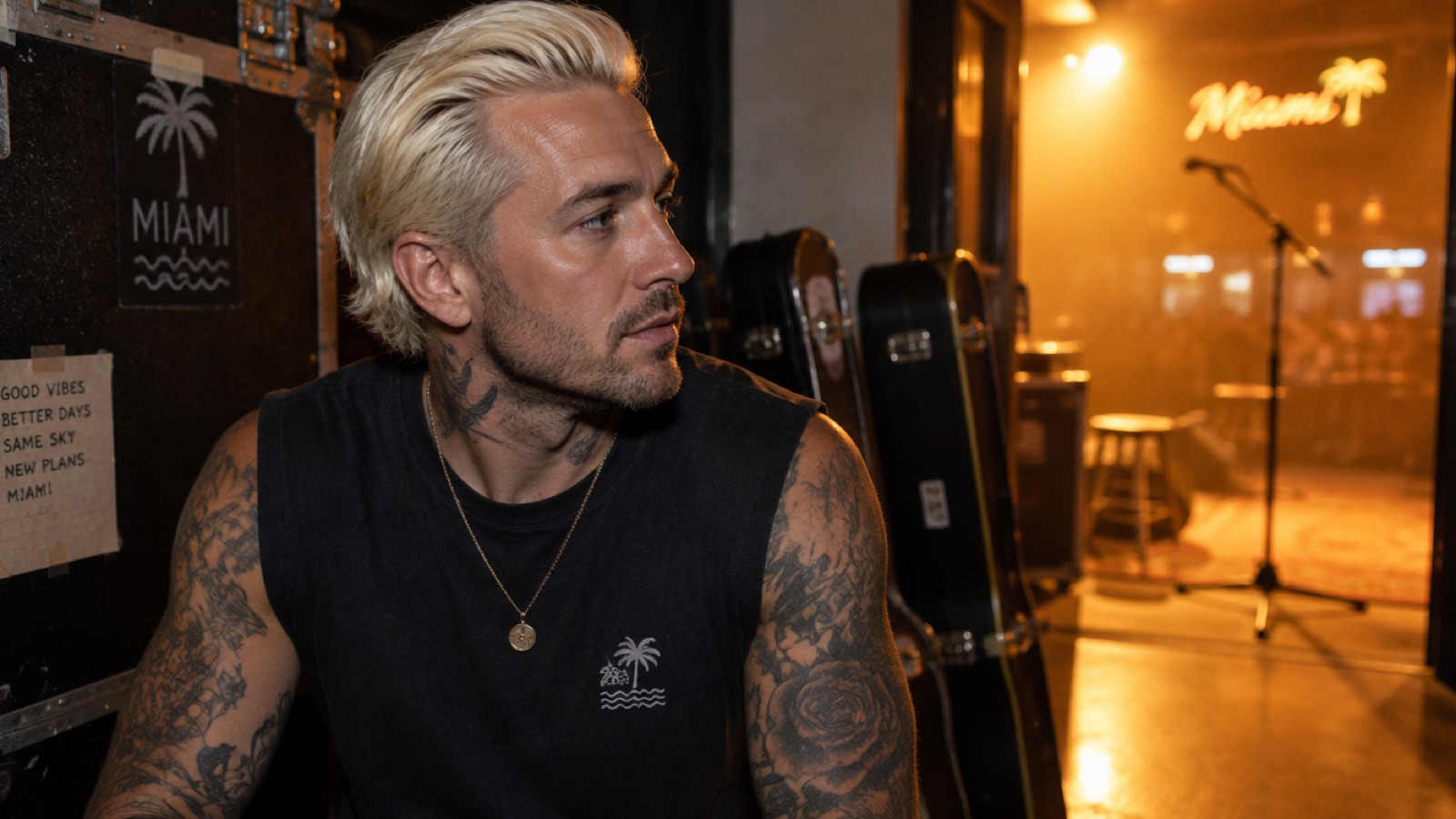
Search for MGK online and a question about a hair transplant comes up fast. The musician and actor, born Colson Baker and known for years as Machine Gun Kelly, has a hairline that looks stronger in recent photos than it did early in the career, and fans have been comparing pictures for a long time. So what is actually known about an MGK hair transplant, and what is just internet guesswork?
The short answer: there is no public confirmation. We could not find an interview or post in which he says he had a hair transplant, and nothing on record names a clinic, a date or a technique. Everything else is inference from photos. In this guide our Aventura team separates what is on the record from what is speculation, explains what the visible changes could and could not mean, and turns it into practical advice for anyone weighing their own options. If you already know you want to explore treatment, our FUE hair transplant in Miami page explains the technique most often mentioned in these discussions.
What MGK Has Actually Said About His Hair
On the specific question of a Machine Gun Kelly hair transplant, the public record is close to empty. He has not confirmed one, has not denied one in any detail we could verify, and has not shared a before and after with a clinic. Articles claiming a precise year, graft count or method are usually a doctor's educated guess or marketing copy written to rank for his name.
What he has made very public is his hair as a style choice. Over the years he has gone platinum, bleached, dyed bright colors, grown it out and cut it short, and those changes are documented in thousands of red carpet and concert photos. That matters for two reasons. First, constant styling changes make photo comparisons unreliable. Second, heavy bleaching is itself relevant to anyone planning a transplant, and we come back to it below.
Our rule for celebrity posts: we only discuss what has been publicly reported or can be seen in public photos, we label speculation as speculation, and we never suggest a public figure was treated at our clinic.
What the Photos Suggest, and What They Cannot Prove
Fans and hair restoration bloggers usually point to the same pattern: earlier photos show more recession at the temples and a less defined front edge, while later photos show a fuller, more even hairline. That is a common story for men who start thinning in their late teens or twenties, and it is consistent with a modest frontal transplant. It is also consistent with several other explanations.
- Medication: finasteride or minoxidil can thicken miniaturized hair at the front and slow further loss, sometimes visibly.
- Styling: swept-forward cuts, textured tops and short sides can make a receding corner almost disappear in photos.
- Color: platinum hair against fair skin reduces contrast, which hides scalp. Dark roots against fair skin do the opposite.
- Camera and lighting: stage lighting, flash and lens angle change how dense hair looks from one photo to the next.
- Cosmetic products: hair fibers, concealers and hair systems are common in entertainment and very hard to spot on camera.
One detail people often raise is that no linear scar has been visible at the back of his head, even with shorter cuts. A strip (FUT) procedure normally leaves a fine line across the donor area, so if a procedure happened, the absence of a visible line would point more toward FUE. Our FUE vs FUT comparison explains why the two methods leave such different donor areas. Still, a well-healed FUT scar under longer hair can be close to invisible, so even this clue is not proof.
If It Were FUE, What Might the Plan Have Looked Like?
We cannot know what was done, if anything. What we can do is describe what a plan for a similar-looking change would typically involve, which is the useful part for most readers. Our wider look at celebrity hair transplants gave a rough estimate of about 1,500 grafts for this kind of frontal refresh. Here is how that kind of number usually breaks down.
| Area | What the change looks like | Typical graft range |
| Temple corners only | Softens a receding "M" shape | Roughly 500 to 1,000 |
| Hairline edge plus temples | A more defined, slightly lower front line | Roughly 1,200 to 2,000 |
| Front third of the scalp | Hairline plus added density behind it | Roughly 2,000 to 3,000 |
| Front plus mid-scalp | Broader coverage for more advanced loss | Often 3,000 or more, sometimes in two sessions |
For context, our clinic can move up to about 4,000 grafts in one day, depending on donor density, and very large plans are split into two sessions. Grafts are extracted by hand with fine handheld FUE instruments, a step-by-step approach described in our Nova Medical FUE protocol. Dr. Adam Rubinstein, MD FACS, a board-certified plastic surgeon, reviews and approves every plan and oversees the procedure.
Why Starting Young Changes the Plan
The most useful lesson from cases like this has nothing to do with fame. It is about age. When thinning starts in the late teens or twenties, the final pattern is still unknown. A hairline that looks perfect at 28 can end up stranded at 45 if the hair behind it keeps thinning and there is no donor supply left to fill the gap.
That is why a responsible plan for a younger patient usually looks a little conservative on day one:
- A mature hairline position: slightly higher at the temples than a teenage line, so it still looks natural in later decades.
- Medication first, or alongside: stabilizing the native hair protects the result and reduces the need for repeat surgery.
- Donor reserve: we protect the donor area from overharvesting and leave grafts in reserve for future loss rather than spending everything at once.
- Staged density: a first session builds the frame; a second, if ever needed, adds density once the pattern is clearer.
If you are in your twenties, our guide to who is a good hair transplant candidate covers the factors we weigh before recommending surgery at all. Sometimes the right answer is to wait, treat and reassess in a year.
Bleach, Color and a New Hairline
Few public figures change hair color as often as MGK, which raises a practical question we hear from patients: can you bleach or dye hair after a transplant? Yes, once the scalp has healed and the grafts are secure. In the first weeks, chemicals and peroxide can irritate healing skin, so the usual advice is to wait several weeks after surgery before any coloring, and longer before strong bleach. Your follow-up visit is the right moment to confirm timing.
Color also changes how a result reads. Light hair on fair skin hides scalp well, so a moderate number of grafts can look full. Dark hair on fair skin shows every gap, so density planning matters more. Curly or wavy hair covers more scalp per graft than very straight hair. We factor all of this in when estimating grafts, which is why two people with the same bald area can receive quite different numbers in their written plans.
What You Can Take From the MGK Story
Whatever happened in this case, the public conversation around it shows a few things clearly. Hair loss in your twenties is common, even among people with stylists and unlimited budgets. A modest, well-placed frontal change can transform how a face looks on camera. And natural results tend to be the ones nobody can confirm from photos, which is exactly what a good transplant aims for.
The design details are what make the difference: single-hair grafts at the very front, a slightly irregular edge rather than a straight ruler line, angles that follow your natural growth, and density that blends into the hair behind it. Our article on designing a hairline for your face shape walks through how those choices are made in a consultation.
Questions to ask before choosing a celebrity-style hairline
- Will this line still suit me at 50? Ask to see where it sits relative to your brows and temples.
- How many grafts does it use, and how many are left? A plan should state both.
- What if my loss continues? Ask how the plan adapts and whether medication is recommended.
- Who does what on the day? Ask who designs the plan and who oversees extraction and placement.
- What results can I see from patients like me? Look for similar age, hair color and texture in the before and after gallery.
Planning a Discreet Procedure in Miami
Most people considering a transplant want privacy, celebrity or not. FUE suits that well: there is no linear scar, recovery at home starts the same day, and many patients go back to desk work within a few days, with a hat covering the scabs that fade in the first week or two. In South Florida, sun protection and avoiding pools and the beach for the first weeks are part of the routine.
At our clinic in Aventura, in north Miami-Dade, the procedure uses local anesthesia with oral pain relief available, and you go home the same day. Pricing runs $3.99 to $7.99 per graft, most procedures fall between $4,000 and $15,000, there are no session fees, and 0% financing is available for the first 12 months. You get a written quote after a free consultation, and you can start with an online photo and video consultation before visiting in person. Patients traveling in through MIA or FLL can use complimentary transportation to and from the clinic, and every patient has 12 months of follow-up. For an overview of every option, see our main hair transplant in Miami page.
Curious What Your Hairline Could Look Like?
Book a free, private consultation in Aventura or start online with a few photos. We will examine your donor area, discuss the look you want and give you a written plan and quote.